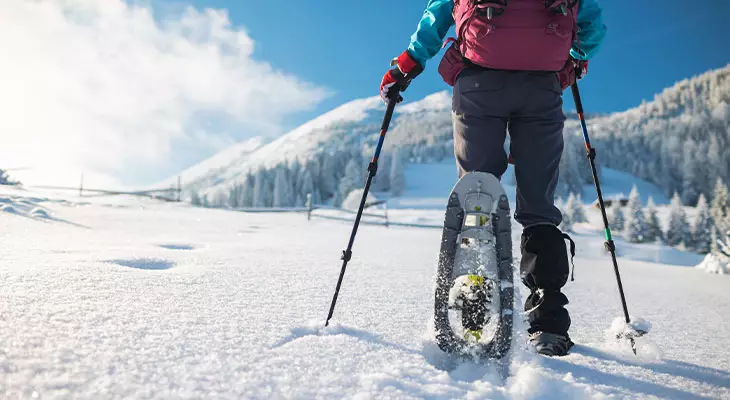
Fancy a snowshoe hike to admire snowy forests and mountains in winter? This activity can be enjoyed with family (children aged 5–6 and up), friends, as a couple, or even solo, and why not with a mountain guide.
But did you know there are certain criteria to consider to make the right equipment choice? Before heading out, learn more about snowshoes: their construction, how to choose a model suited to your use and body type, and useful complementary accessories. With this quick guide, you'll know everything to find snowshoes with the best value for your goals and budget.
Snowshoe construction
The first snowshoes were made of wood. They are still in use, but today most sport-oriented snowshoes are made from aluminum (tubular) or plastic. Like skiing equipment, modern designs provide more comfort, safety, and performance on different snowy terrains.
Aluminum snowshoes have the advantage of being lightweight and are perfect for walking on flat terrain. However, plastic snowshoes remain the most commonly used. Unlike aluminum models, they are better suited for hilly terrain or rough trails.
A snowshoe consists of a frame with a deck (under your foot, which increases contact with the snow), a heel lift (to raise your heel for easier uphill climbs), front and rear crampons and claws (sometimes on the sides depending on the model, for better grip on slopes), and strap or ratchet bindings.
How to choose the right snowshoes
Snowshoes should be flexible and allow easy movement to accompany your foot and leg movements naturally.
The more uneven the terrain, the more you should prioritize a lightweight pair with maximum crampons and claws for the best possible grip. If you want freedom of movement but are unsure how to choose, go for narrow decks. While heel lifts are not always standard, they are essential for uphill climbs.
Naturally, more advanced models with these features are also more expensive.
For walking on flat terrain and powder, a wider deck is better, providing increased stability.
There are also racing snowshoes if you plan to cover mostly flat surfaces (without powder).
Choosing snowshoes according to your body type
Unlike skiing, size is not the main factor in finding snowshoes that fit. However, ask yourself how to choose a pair based on your weight. Make sure to account for your weight plus your gear (clothing, backpack, boots) to achieve proper floatation on snow. Above 75 kg, it is better to choose snowshoes with a longer and wider deck for more stability, preventing you from sinking too deeply into soft snow.
There are men’s, children’s (up to 50 kg), and women’s (lighter) models. Women’s models typically have narrower decks, which may not suit taller users. Wider decks provide more flotation and stability but increase the overall weight of the snowshoe.
What about choosing snowshoes based on shoe size? The adjustment system at the back modifies the shoe size. Avoid overly tight bindings, as they can hinder walking and reduce blood circulation in extreme cold.
If you rent your snowshoes at Sport 2000, you will have access to top brands (TSL, MSR, etc.) and advice to make the right choice. Staff will explain how to use heel lifts and adjust the bindings properly, and can also suggest hiking routes adapted to your level and children.
Essential or useful accessories
Now that you know how to choose your snowshoes, think about complementary equipment.
First, snowshoes require poles. Without them, balance is harder to maintain. Poles provide stability and traction, especially on rough terrain. They make walking and obstacle crossing easier, reducing leg fatigue on long or difficult hikes.
For safety, most professionals strongly recommend carrying an avalanche beacon (DVA), a probe for locating victims under the snow, and a shovel for emergency digging.
To cope with winter mountain conditions, don’t forget sunglasses, gloves, a hat, and waterproof boots, and you’re ready to hit the snowshoe trails!
Check out our advice for choosing your ski equipment, picking the ideal ski backpack, preparing your ski trip, and more.