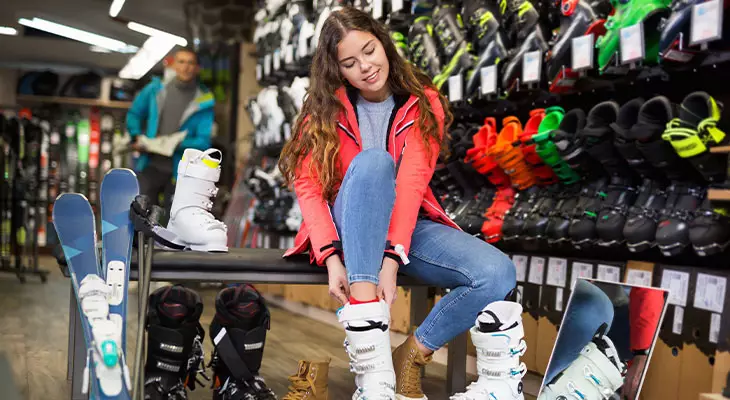
Essential for skiing all day comfortably, without pain or risk of falling, choosing the right ski boots is no small task, especially for beginners. Whether you want to buy or rent a pair at a Sport 2000 store, here are some professional tips for picking the right ski boots. Also, check our guide on how to choose your ski equipment, and other advice for all your skiing gear and accessories.
Choosing the right boot size
To select the right ski boots, you need to focus on the exact size of your feet rather than your usual shoe size. Unlike everyday shoes, ski boots are chosen based on your actual foot length. Many beginners ignore this and end up with boots that are too large, providing insufficient ankle support.
So, how do you measure your foot accurately to buy or reserve ski boots online? It's simple: take an A4 sheet of paper and place it against a wall. Stand with your heel against the wall, place your foot on the paper, and make a pencil mark at the tip of your toes while performing a slight flexion, similar to the stance you have while skiing.
Repeat with the other foot and measure the distance from the edge of the paper to the pencil mark. To choose your ski boots, use the larger measurement of the two feet: this prevents one foot from being too tight while the other fits comfortably. If you are between two sizes, select the smaller size, since the liner will compress with wear.
Tip: rental boots are usually 100 mm wide, which fits most skiers. However, if you have wider or narrower feet than average, don’t hesitate to ask for advice in-store. Take advantage of professional guidance when collecting your boots to adjust the buckles correctly.
Flex: a key factor when choosing ski boots
Another important factor is the boot flex, which indicates the stiffness level. A boot with a flex of 120–130 is much stiffer than one with 60–70. But how do you choose ski boots based on flex?
Simple rule: the softer the boot, the more suitable it is for beginners. Beginners should choose boots with a flex index between 60 and 90 for men, and 60–70 for women. Professional skiers typically opt for very stiff boots with a flex between 130–150.
If you ski occasionally during holidays, the ideal is boots with a flex between 90–110 for men, or 70–90 for women. These boots are comfortable yet provide sufficient ankle support for more challenging runs and sharper turns, striking a good balance between precision and comfort.
Boot type according to discipline
Just like choosing skis, the type of skiing affects the boot selection. Alpine skiing boots are among the stiffest to provide control and precision. Freestyle boots are softer, allowing more ankle flexibility and freedom of movement. Freeride boots must be versatile, suitable for all terrains and snow types while maintaining proper stance.
Cross-country skiing requires yet another type of boot. That’s why when you rent equipment online with Sport 2000 for classic or skating cross-country skiing, you get a complete pack of skis, boots, and poles.
We also have a complete guide on