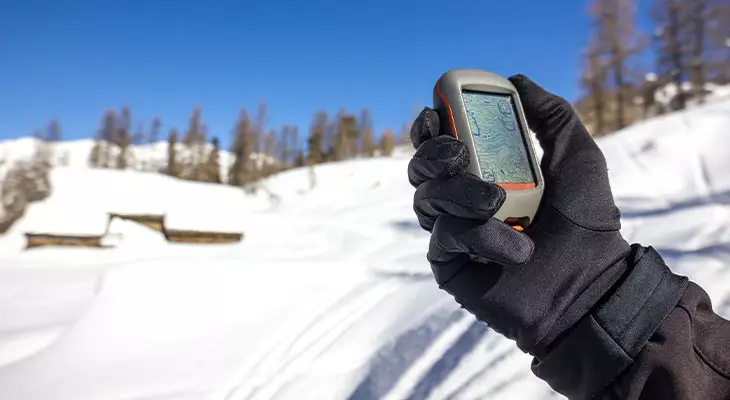
Operating without batteries, a GPS (Global Positioning System) allows you to locate yourself in the mountains via satellite. Regardless of weather conditions, it instantly provides a user with their exact position or the route to follow. This makes it a valuable tool for skiers who enjoy off-piste adventures. A ski GPS can be a standalone device, or integrated into a smartphone or smartwatch.
So, how do you choose the right GPS? Here are Sport 2000’s tips to equip yourself properly for skiing.
Why use a ski GPS in the mountains?
Not all winter outdoor activities require a navigation system. If you stay on alpine ski slopes or do cross-country skiing, the risk of getting lost is low, and a trail map (digital or paper) is usually sufficient.
However, if you plan to go off-piste with freeride skiing, ski touring, or even snowshoe hiking, a GPS becomes very useful. It’s especially helpful if you’re unfamiliar with the ski area or if the weather deteriorates, making it difficult to find your way. Functions include route planning with IGN maps and finding your way back to the resort if you get lost.
Of course, owning a GPS device or watch does not replace essential mountain safety precautions: check weather and avalanche risks, always inform someone of your plans and routes for off-piste skiing, and when in doubt, turn back.
Which standalone GPS device to use when skiing?
Before even renting skis or going ski touring or freeriding at Les Arcs, La Clusaz, or Val Thorens, you need a reliable GPS device for ski navigation.
Ski GPS device: definition
A standalone device, the GPS unit stores digital maps in memory. Battery-powered, its screen size offers a comfortable reading experience.
A GPS device provides essential information such as weather or altitude via an integrated altimeter.
Some models connect to a smartphone, allowing real-time data transfer through a mobile app.
GPS devices for hiking (also called ski GPS) may feature a touchscreen or a joystick (cheaper option).
These devices are sturdy (though bulkier than smartwatch GPS), offering high resistance to shocks and cold.
Note that some hiking GPS units lack a compass or IGN map, which provide access to useful features like photos of the planned route. This should be considered when comparing GPS options.
Key features of a ski GPS
Many outdoor enthusiasts use the same GPS for multiple activities: skiing, hiking, cycling, trail running...
Due to rapidly changing weather at high altitudes, a good ski GPS must include several essential features to allow skiers to venture safely.
Beyond digital cartography (IGN maps), a good ski GPS will feature vector maps for easier reading.
A "Trackback" function records the route you’ve traveled, useful if you get lost and need to retrace your steps.
The route creation function allows a skier to plan their course or choose paths already taken by other skiers using this feature.
The LiveTrack function (on Garmin GPS) lets a skier share their planned route and real-time position with others. With such a GPS, you can track a skier’s location or intervene in case of emergency.
Note that GPS devices differ from smartphones with hiking GPS apps. While smartphones can perform similar functions, they are less robust (waterproofing, cold resistance) and have shorter battery life, often requiring a spare battery.
To ensure high-quality equipment, choose from top GPS brands like Garmin, TwoNav, or Globe. Expect prices between €300 and €500 for fully featured models.
Which ski GPS watch to choose?
Prefer having GPS information on your watch and mobile app? A good ski GPS watch should offer the same mapping and location features as a standalone GPS.
A ski GPS watch must withstand extreme weather conditions: silicone strap, anti-glare screen with backlight, waterproof casing, stainless steel, sapphire glass or polymer fibers, and possibly an oximeter to detect avalanche risk.
Choose a model specifically designed for skiing, as many GPS watches are general-purpose or for other sports (running, trail, diving, cycling, cardio training, etc.).
Ski GPS watches are easy to use, come in a variety of designs, and provide real-time data and health/sport features (heart rate, blood oxygen saturation for high-altitude acclimation, calories burned, elevation, barometer, compass, altimeter…). Some models include an SOS call function.
Drawbacks include a smaller screen compared to a standalone GPS and shorter battery life.
Recommended brands include Garmin, Coros, and Suunto. Mid-range models are priced around €300–€400.