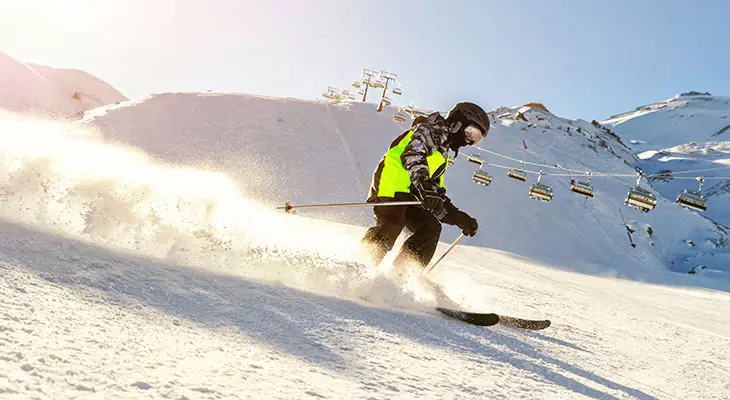
Braking is a fundamental ski skill and can be done in several ways. There’s the <strong"snowplow position<="" strong="">, which is ideal for beginners, as well as skidding, turning, and the "stair-step" technique for more experienced skiers. If you’re just starting out, the best way to learn how to brake is by taking private or group lessons, which will help you progress faster. Discover all of Sport 2000’s tips to learn how to brake on the slopes and enjoy your winter holiday safely.
Why mastering ski braking is essential
If you’re a beginner skier, one of the foundations of skiing is knowing how to stop or at least slow down. Whether you are alpine skiing on a piste, skating in cross-country skiing, or freeriding, braking ensures you have control over your skis. It allows you to move safely, both for yourself and for others on the slopes.
Warning: knowing how to stop doesn’t replace following slope safety rules. Remember that skiers downhill have the right of way and never stop in the middle of a slope or a turn.
How to brake using the snowplow
The snowplow technique is the basic method for braking. For beginners, it’s the easiest way to stop. Even when you reach a higher level, this technique remains useful, especially for braking in tight spaces or when you don’t have enough room or speed to skid.
To perform a snowplow brake: bend your legs slightly and lean forward (pressing your shins against your ski boot tongues). Keep your back straight. Bring the tips of your skis close together and push your heels apart simultaneously, forming a triangle with your skis. To brake more strongly, simply widen your heels further.
This technique works perfectly for stopping at low speeds. At higher speeds, skidding is more effective for braking quickly.
Be careful not to cross your skis, as this may cause you to fall.
How to brake using a skid
Skidding is a skill that separates beginners from more experienced skiers.
Keep your skis parallel and angled toward the slope. Face the slope with your upper body, bend your knees, and position your skis perpendicular to the fall line. Press your weight on the uphill ski (the ski opposite the descent) using your knees.
The more you bend your legs at a right angle, the more precise your skid will be.
When turning your skis perpendicular to the slope, move both skis at the same time to keep them parallel—otherwise, you risk falling.
Skidding is more efficient than the snowplow, but you still need some space to stop. Make sure the slope is clear of other skiers. Also, check the snow conditions: it’s easier to skid on fresh or groomed snow than on ice. If you encounter ice, remain calm and initiate a gentle skid, keeping your legs bent, until you reach a safer snow section to stop completely.
How to brake while turning
This technique isn’t meant for a full stop but helps you slow down gradually. It’s useful when you feel you’re gaining too much speed.
To turn, shift your weight onto the outside ski (the ski on the downhill side) in the direction you want to go. Bend your knees, plant your pole (right for turning right, left for turning left), and push on it while guiding your body around it.
How to brake using the "stair-step" method
Another way to slow down is the "stair-step" technique. It’s not meant for stopping immediately but allows you to reduce speed gradually.
As you change direction, instead of continuing down, move slightly uphill with your skis perpendicular to the slope, lifting one ski at a time toward the uphill side, as if climbing a staircase.
Make sure no other skiers are coming down this section and that the slope is wide enough.
Ready to put these techniques into practice? Reserve your skis, boots, and poles online with Sport 2000 and hit the slopes! Consider taking lessons to learn braking techniques from an experienced instructor for personalized guidance.