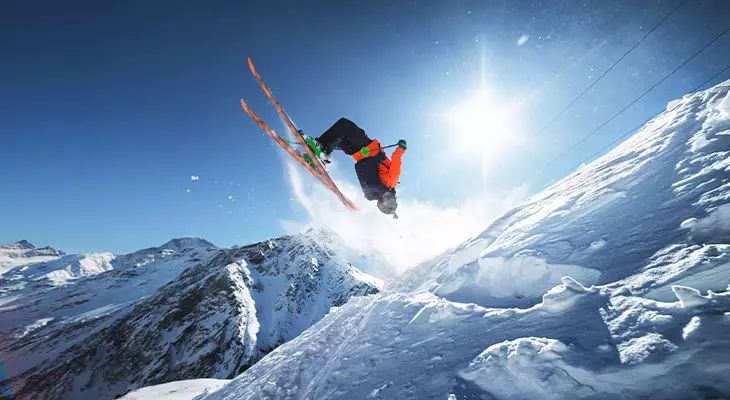
Until a few years ago, freestyle skiing was still relatively uncommon, but each year it attracts more and more fans seeking new thrills.
Sport 2000 guides you with expert tips on how to choose freestyle skis, whether you are a beginner, intermediate, or advanced skier!
What Makes Freestyle Skis Different from Classic Skis
Knowing how to choose freestyle skis is important because this discipline is very different from alpine or cross-country skiing. The demands are not the same, and the characteristics are therefore very specific. Freestyle skis need to be lighter and offer greater maneuverability, as well as better shock absorption. But what exactly makes them different from your standard alpine skis?
First, freestyle skis are equipped with a double tip, meaning the front and tail of the ski have the same shape, unlike alpine or cross-country skis. These are called "twin-tip" skis. This feature is crucial because it allows freestylers to ski both forwards and backwards. Some models also feature dual rockers: raised tips at both the front and back.
Choosing freestyle skis also involves opting for skis with a camber designed specifically to absorb shocks. This is why freestyle skis often have a flat camber.
This allows the freestyle skier to land more smoothly when performing tricks, protecting both the equipment and the athlete’s joints.
Finally, the flex is usually softer to provide more rebound on jumps, make certain tricks easier, and better absorb impact on landing. There are also freestyle skis with stiffer flex for increased stability and better edge control.
Freestyle skis therefore have many unique characteristics, both in terms of size (length, waist width, tip and tail width) and shape (rocker, camber, etc.), to meet the demands of this adrenaline-packed winter sport.
What Ski Length to Choose for Freestyle?
To know how to choose freestyle skis, and specifically the right length, you need to consider several factors: the skier’s level, weight, and the type of freestyle they want to practice, as there are several variations.
- For backcountry freestyle, which is performed off-piste on natural obstacles, it is recommended to choose skis with a length equal to your height minus 5 to 15 cm.
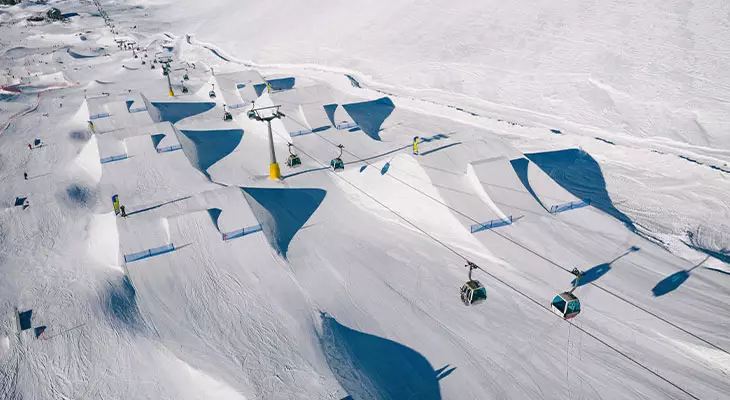
- For slopestyle, which is performed on man-made obstacles, or for freestyle in the Snow Park, skis that reach your height or just below are perfect.
- For classic freestyle, mostly performed on ski slopes, you can choose skis about 10 cm shorter than your height.
Whatever your level or freestyle style, you will find a suitable pair of skis in our online store as well as in our Sport 2000 rental shops. In addition to offering skis from top manufacturers (Volkl, Atomic, K2, Black Crows, Faction, etc.), our teams provide valuable advice on choosing the right type of skis and bindings for your level and requirements. They can also adjust the bindings according to your weight, boot size, and skill level.
Note that when renting freestyle skis (as with alpine piste skis, freeride skis for powder, or all-mountain skis for versatile use), poles are included. Like skis, poles for freestyle are generally lighter and shorter, offering greater freedom and maneuverability during jumps.
Starting Freestyle Safely
Freestyle is very different from alpine skiing, which is why it is essential not only to choose the right freestyle skis but also to equip yourself with all the necessary gear for safe practice. For this reason, on our website and in all Sport 2000 stores, you will find helmets specifically designed for freestyle skiing. Helmets are strongly recommended for all skiers, and even more so for freestylers, whether in the backcountry, on slopes, or in the Snow Park.
Likewise, don’t hesitate to use wrist guards, as freestyle is a challenging discipline that inevitably involves many falls when starting out. You can also opt for back protectors to protect your lower back, neck, and spine in case of a fall.
Important to know: freestyle skiing requires specific ski boots that are particularly tight to support the skier’s movements. Choosing freestyle skis therefore also involves selecting the right boots.
Looking for other thrills beyond freestyle, on slopes or in powder snow? Sport 2000 also guides you in choosing the right snowboard, gives advice on finding the right all-mountain skis, and helps you improve your skills to ski moguls, among others.